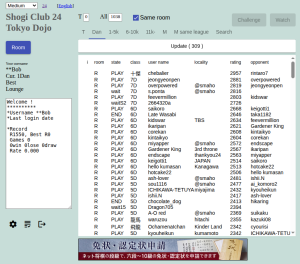
If you’ve ever played shogi online, there’s a good chance you’ve heard of Shogi Club 24, also called “24”, or “ni-yon” in Japan. It’s the plain-looking site that still manages to feel like a real dojo: serious games, strong opponents, and a rating that people actually respect. It also has 300,000+ registered members, and you can register and play for free.
And now for the part that makes your stomach drop, …
Shogi Club 24 is scheduled to shut down on December 31, 2025.
Yes. That Shogi Club 24–the one that helped shape online shogi for more than two decades–is about to become history.
So… what is Shogi Club 24, exactly?
Shogi Club 24 is the official online shogi site connected to the Japan Shogi Association (日本将棋連盟), with day-to-day operation handled by Shogi Club 24 Ltd. (有限会社将棋倶楽部24) and its long-time “dojo master” (席主 / sekishu) Hiroshi Kume (久米宏).
A few things that define 24:
- It’s focused on real shogi practice. This isn’t a flashy app-first game. It’s more like walking into a quiet training room.
- It’s built around rating. People care about their number. A lot.
- It’s “always on.” You can play in the Tokyo or Osaka “dojos,” and you’ll often find games even at odd hours.
- It’s free to use at the basic level. That’s part of the magic and part of the problem.
The history of Shogi Club 24, start to finish
1998: The beginning (the internet was still “new”)
Shogi Club 24 started in late 1998. In the shutdown announcement, Kume writes that he opened 24 at the end of 1998 and has provided the service since then.
Japanese coverage adds an important detail: it began as an in-house venture project while Kume worked at Fuji Xerox (now Fujifilm Business Innovation).
That timing matters. This was the era when:
- Home internet was still spreading.
- Playing strangers online felt almost futuristic.
- A “shogi server” wasn’t a normal thing yet.
24 helped make it normal.
1999: Early community (and Kume was already surveying users)
One of my favorite “history clues” is that Kume ran user surveys even back in 1999, posting results like “most users are in their 20s” and encouraging more women to join. It feels small, but it shows something important: 24 was never just code–it was a community being actively cared for. [5]
2001: A real company forms
The operating company, 有限会社将棋倶楽部24, was founded on May 1, 2001, with Kume listed as the director.
That’s another key moment: 24 was no longer just a hobby project. It had become a real service with real responsibilities.
2005: Peak “internet dojo” energy
In the 2005 user survey, the response count is described as a record high (過去最高), with thousands of replies. Kume comments on how the player base was broadening across ages, including more older players.
That lines up with what many long-time players remember, 24 was “the place” for serious internet shogi.
2006: The Japan Shogi Association connection becomes official
According to the Japanese Wikipedia entry, on November 1, 2006, the internet shogi business was transferred to the Japan Shogi Association, making 24 an official JSA site. Even after that, operation was still essentially entrusted to Kume’s side. The JSA connection gave legitimacy, but it didn’t magically create a big development team.
2007: “Xは誰だ?”—pros, hidden identities, and the fun side of 24
In 2007, 24 hosted a collaboration with the shogi magazine 将棋世界 called “Xは誰だ?” (“Who is X?”). Pro players used hidden accounts (like “@X”) and users tried to guess who they were.
This is one of those moments that shows how deeply 24 was tied into shogi culture, not just casual play, but the wider world of shogi fans and professionals.
The “24 rating” becomes a benchmark (and it’s famously tough)
A big reason 24 became legendary is the rating culture. The Wikipedia entry even notes a rough comparison that a 24 shodan might be closer to a “real-life dojo sandan.” In other words, 24 can be brutal. And that “tough dojo” vibe is exactly why people who want to improve keep coming back.
2011: Computer shogi shows up inside 24
24 also became a place where computer shogi (AI engines) brushed up against human players. Wikipedia describes a system where software developers can register, creating accounts that start with “@”, and some famous engines played games on 24. Even if you never faced one of these accounts, the fact that 24 was part of that era says a lot: it stayed relevant through huge changes in shogi.
2013: Two big shifts: official amateur certification and mobile apps
In 2013, 24 tied into official amateur ranking paperwork: players above a certain level could apply for JSA-issued amateur rank certificates (認定状), up to a high amateur dan level.
And on the mobile side, 24’s app model became clearer: the official app allows one free game per day, with paid options for unlimited games and extra features like kifu search.
2015: The world turns to smartphones and 24 users do too
The 2015 user survey includes a line that jumps out today: smartphone use passed 50% among respondents, and tablet ownership was rising fast. This is the era when “PC-first” became “mobile-first” in everyday life. 24’s audience was changing even if the site’s DNA wasn’t.
2017: Pros and future stars are part of the 24 story
Many pros used 24 in one form or another. A Japanese news article notes that 24 was used not only by amateurs but also by many professional players, and it even mentions a past interview where Sota Fujii talked about his 24 rating at different ages.
This is one reason 24 feels “serious” in a way that’s hard to fake. People know that strong players trained there.
2018: Fischer time arrives, … at least on mobile
Wikipedia notes that Fischer time (increment time control) was introduced for mobile games in 2018. That may sound technical, but it’s another sign of 24 evolving slowly and carefully, while trying not to break what people love.
2020: The HTML5 era: goodbye Java… mostly
For years, 24 was tied to Java for its classic PC environment, and many players basically installed Java just for 24. Official pages still describe the older setup as requiring Java for the application-style dojo.
But by 2020, 24 had an HTML5 dojo, which opens in a browser and doesn’t need Java.
One more important detail: the HTML5 dojo page explicitly notes that smartphones and tablets were not supported yet, with “future plans” mentioned. So even as 24 modernized, it still wasn’t fully meeting the “everyone plays on their phone now” reality.
2023: Players still want the same thing: to get stronger
The 2023 user survey includes a line saying smartphone users were over 80%, and that the top thing people want is, unsurprisingly, “I want to get stronger.” That sentence alone explains so much of 24’s pull. It’s not just a place to kill time. It’s a place to work.
2025: The shutdown announcement
On October 1, 2025, Kume posted the official announcement:
- 24 has been running since late 1998.
- He had been thinking about retiring.
- There is no successor ready to take over.
- Continuing past 2025 would be difficult.
- The service will end on December 31, 2025.
On the top page, there’s also a message that hits hard in a quiet way: there are many shogi sites now, so please find one that fits you and keep playing.
And there’s a practical note too: the site indicated it would remain available for a limited time after the end of service for things like record searching, and the smartphone app would be made free during December, with refund info for remaining premium time.
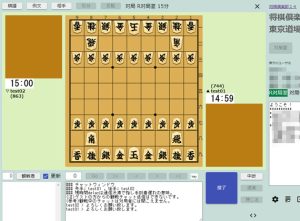
Why people love Shogi Club 24 (and stay loyal to it)
It’s easy to describe 24 in terms of features like rating, time controls, and dojos. But that’s not the whole story.
It feels like a real dojo, not a “game”
A lot of online shogi today is fast, flashy, and optimized for quick matches. That’s fun, but it’s not always great for deep practice. 24 has always been the place where you log in because you want to improve. The user survey literally says that “I want to get stronger” is the #1 desire.
The rating means something
On 24, your rating is not just a badge. It’s a reputation. And the environment is known to be strong. That shared respect for the rating creates a kind of seriousness you can’t copy with a new UI.
Simple design = fewer distractions
You don’t come to 24 for animations. You come for shogi. The interface and the culture push you toward the board, the clock, and the moves. That’s part of why it became a training ground for so many strong players.
It has history baked into it
It’s not just “an online server.” It’s where shogi culture lived through:
- the early internet days,
- the rise of pro shogi fandom online,
- the AI boom,
- and the shift to mobile.
That’s why people talk about 24 like it’s an era, not a website.
Why Shogi Club 24 is shutting down
This is the hardest part, because there’s the “official reason” and then there’s the “bigger picture.”
The official reason: retirement + no successor
Kume’s shutdown notice is very clear: he’s been thinking of retiring, and there isn’t a trained successor to hand the service to. So he concluded he can’t keep it going past 2025.
That’s the core explanation, straight from the source.
The structural problem: it’s been too dependent on one person
Multiple sources describe how much of the operation rested on Kume alone. The J-CAST article says he has been handling management and operation by himself. The Japanese Wikipedia entry also notes the employee count as essentially one.
Running a beloved service like this for decades is impressive. But it also means the service is fragile.
The context: shogi moved to phones, and the world moved with it
Mainichi reporting on the shutdown also points to the shift of online play toward smartphones and a decline in users. Basically, “the times changed.” And you can see that shift in 24’s own surveys: smartphone usage climbs from “over 50%” (2015) to “over 80%” (2023).
The “unofficial” reasons people discuss
In the community, people bring up other pressures too, like the burden of keeping a mostly-free service running while also dealing with problems like cheating (software assistance). One user on the official 24 bulletin board even says that doing anti-cheating measures on a mostly free service must be a heavy load.
To be clear: that’s not an official statement. But it shows what users suspect and worry about.
User reactions: shock, gratitude, bargaining… and a lot of sadness
When a service lasts 27 years, it becomes part of people’s routines. So the reaction wasn’t just “oh no.” It was personal.
1) “Wait… seriously?” (pure shock)
On the 24 bulletin board, you see posts that are basically disbelief: “Is it really ending?” That’s a normal reaction when something feels permanent.
2) Nostalgia hits hard
In Japanese social media reactions quoted in news coverage, people remember the dial-up era. They remember using night-time internet plans and finding it hard to log in after 11 p.m. because so many players were online.
3) Gratitude (even from people who are devastated)
Many reactions are basically: this changed shogi. One quoted post says 24’s impact on the shogi world is impossible to measure. That’s the tone you see over and over: sadness, but also respect.
4) People try to “solve” it: proposals to keep it alive
On the official bulletin board, users suggest all kinds of ideas:
- reduce operating days (like weekends only),
- make it paid (monthly or yearly),
- publicly recruit successors,
- or find a way to hand it off safely.
5) Some accept it… because they don’t want a messy ending
Not everyone argues. One post suggests that ending while people still love it might be “beautiful,” instead of forcing a half-working continuation. That’s a painful point, but it’s also an honest one.
6) The big fear: “Where do we go to play slow, serious shogi?”
A lot of players don’t just want any online shogi. They want the 24 style: serious games, traditional time settings, not everything decided by ultra-fast blitz. In the bulletin board thread, someone explicitly says they don’t click with “kiremake” (sudden-death style) services like Wars.
That’s the real grief: it’s not just losing a website. It’s losing a kind of place.
7) Other platforms react (but even they admit they can’t replace it)
One of the most interesting responses came from Shogi Wars. They posted an announcement saying they planned:
- account linking with Shogi Club 24,
- auto-matching with 24-style time settings,
- ways to look back at your 24 history,
- and even a small bonus avatar to honor Kume.
And they also say something important: they can’t truly replace 24. They’re trying to give 24 players a bridge, not a copy.
A quick personal note …
If you’re a 24 player, I hope you get to play a few more games before the end. And I hope wherever you land next, you keep the best part of 24 with you:
That simple goal, … “I want to get stronger.”