By Galo S Mirth
The World Computer Shogi Championship (WCSC, 世界コンピュータ将棋選手権) is the central annual competition of computer shogi. Organized by the Computer Shogi Association (CSA), it became the benchmark event where developers test not only software ideas but also practical engineering choices such as hardware setup, stability, and match operation.
Before 2001, the event name was コンピュータ将棋選手権. From the 11th edition, it adopted the current “World” name as international participation became more regular. Over the decades, WCSC became the stage where major generations of engines appeared, from handcrafted evaluation eras to Bonanza-style machine learning and later deep-learning systems.
What WCSC is trying to do
CSA’s WCSC policy states three core ideas: fair tournament management, deciding the strongest computer shogi entry, and encouraging交流 (exchange) among developers. Another defining point is that WCSC does not impose strict hardware limits on participants. In practice, this has made WCSC a full-stack competition, where algorithm quality and compute strategy are both part of the contest.
Typical tournament format
Recent WCSC editions generally run over Golden Week in a three-day structure:
- Day 1: First qualifying stage (Swiss style) for non-seeded teams.
- Day 2: Second qualifying stage (Swiss style) combining seeded teams and qualifiers.
- Day 3: Final round-robin among top finishers.
Publicly shared rule summaries for recent editions also describe fast controls using Fischer-style increments, and practical regulations for equipment and operations. Exact details can vary slightly by year, so serious historical comparison should always check each edition’s rule sheet.
Notable eras and winners
Early foundation era (1990s to early 2000s): programs such as 極/金沢将棋, IS将棋, 柿木将棋, and YSS repeatedly reached the top. This period built core search and evaluation traditions in Japanese computer shogi.
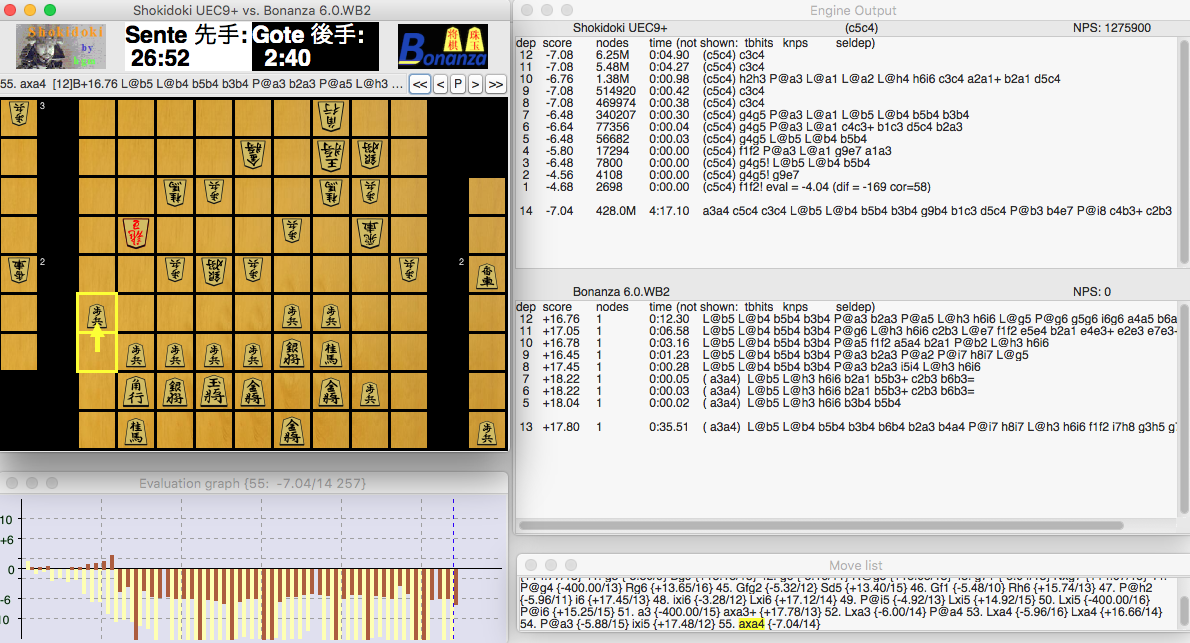
Bonanza shock (mid-2000s): Bonanza’s 2006 title win became a major turning point. Contemporary reporting highlighted both its tournament impact and its data-driven evaluation approach, which influenced many later engines.
Transition to modern heavyweights (2010s): GPS将棋, Ponanza, Apery, and elmo represent a period of rapid strengthening, larger computation, and stronger opening/endgame integration.
Deep-learning era (late 2010s onward): newer systems including dlshogi with HEROZ and related descendants brought neural approaches into the center of WCSC competition. The event also adapted through disruptions such as the 2020 cancellation of the on-site championship and the online substitute tournament.
Why WCSC mattered beyond one tournament
WCSC has been more than a yearly ranking event. It shaped development culture in at least three ways:
- It rewarded reproducible, match-ready engineering, not only raw research ideas.
- It accelerated diffusion of strong methods from leading teams to the wider scene.
- It provided a shared proving ground that fed into later public events, commercial software, and broader computer-shogi visibility.
Sources (Japanese)
- コンピュータ将棋協会 公式サイト(世界コンピュータ将棋選手権 各回ページ・大会情報): https://www.computer-shogi.org/
- 世界コンピュータ将棋選手権ポリシー(CSA): https://www.computer-shogi.org/wcsc/policy.html
- 世界コンピュータ将棋オンライン大会(2020): https://www.computer-shogi.org/wcso1.html
- 日本語Wikipedia「世界コンピュータ将棋選手権」(oldid=106966325): https://ja.wikipedia.org/w/index.php?title=世界コンピュータ将棋選手権&oldid=106966325
- マイナビニュース(2006/05/08, アーカイブ)「フリーソフト『Bonanza』が初出場で優勝」: https://web.archive.org/web/20140215095204/http://news.mynavi.jp/articles/2006/05/08/shogi/